World's Business and Economy

The Business, Economy and Enterpreneurship news from all around the world.

Science and Technology

All sorts of news from the sector of Science and Technology.

LifeStyle

Provide the news of people's Lifestyle.

Art, Architecture and Culture

Art, Architecture and Culture news around the world.

Education

Provide Education related all kind of news.

Showing posts with label Environment. Show all posts

Sunday, May 10, 2015

Dazzled by Australia's precious opals


Dazzled by Australia's precious opals

It's exactly 100 years since the teenage Willie Hutchinson stumbled across a few pieces of opal while walking in the Australian Outback.

There with his father to prospect for gold, the youngster's chance find led to a gemstone mining boom and the establishment of the town of Coober Pedy.

Today, the settlement even refers to itself as the "opal capital of the world", with the wider Australian deposits producing more than 80% of the world's precious opals.

Coober Pedy's gemstones are known for their clear or whitish colour, but some will dazzle like a rainbow. Experts talk of "church windows" to describe examples that mimic stained glass.

Already legally defined as Australia's "National Gemstone", the precious opals could be in line for a new status - that of Global Heritage Stone Resource (GHSR).

Read the full article here.

Thursday, May 7, 2015

Ten giant animals that are long since dead


Ten giant animals that are long since dead

Today Earth is home to the heaviest animal that has ever lived: the blue whale. As far as we know, no past animal has ever weighed more. But some have been longer.

While the large dinosaurs tend to grab more than their fair share of attention, there have been many other giant animals that we will never get to see in the flesh. Some are the super-sized ancestors of creatures alive today, while others appear especially bizarre to us because they left no descendants.

The remains of yesterday's giants can help us understand how conditions on Earth have changed across the ages, because creatures often changed size in response to changes in the environment. Besides, there is something inherently fascinating about big animals that we can only see in our imaginations. Here are 10 particularly awesome extinct giants.

Aegirocassis benmoulae

What would the offspring of a whale and a lobster look like? If such a thing were possible it might look something like Aegirocassis benmoulae.

Read the full article here.

Thursday, April 30, 2015

Sentinel satellite reveals Nepal quake movement


Sentinel satellite reveals Nepal quake movement

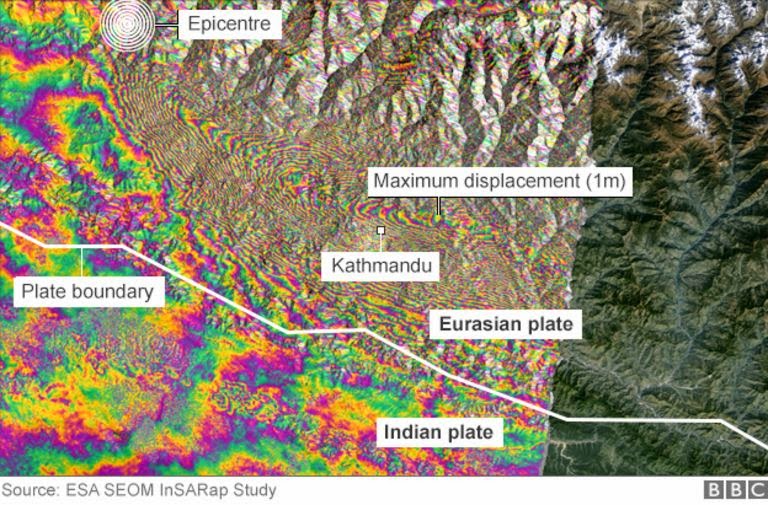
Europe's Sentinel-1a satellite has got its first good look at the aftermath of Saturday's big quake in Nepal.

The radar spacecraft is able to sense ground movement by comparing before and after imagery acquired from orbit.

Scientists turn this information into an interferogram - a colourful, but highly technical, representation of the displacement that occurs on a fault.

The new data confirms an area of 120km by 50km around Kathmandu lifted up, with a maximum of at least 1m.

"There's a peak of slip just to the northeast of Kathmandu. Basically, what we do is count the coloured 'fringes' in this interferogram and there are about 34, so that translates to more than a metre of uplift," explained Prof Tim Wright from the UK's Nerc Centre for the Observation and Modelling of Earthquakes, Volcanoes and Tectonics (COMET).

Read the full article here.

Wednesday, April 29, 2015

Amazon: 1% of tree species store 50% of region's carbon


Amazon: 1% of tree species store 50% of region's carbon

About 1% of all the tree species in the Amazon account for half of the carbon locked in the vast South American rainforest, a study has estimated.

Although the region is home to an estimated 16,000 tree species, researchers found that just 182 species dominated the carbon storage process.

Amazonia is vital to the Earth's carbon cycle, storing more of the element than any other terrestrial ecosystem.

The findings appear in the journal Nature Communications.

"Considering that the Amazon is massively important for the global carbon cycle and stores so much of the planet's biomass, finding out just how that carbon is stored and produced is very important if we want to understand what might happen in the future in different environmental conditions," explained co-author Sophie Fauset from the University of Leeds, UK.

The tropical forest covers an estimated 5.3 million sq km and holds 17% of the global terrestrial vegetation carbon stock.

Read the full article here.

Monday, April 27, 2015

Why Nepal is so vulnerable to quakes


Why Nepal is so vulnerable to quakes

The pictures emerging from the Nepalese capital, Kathmandu, are shocking.

Durbar square, a Unesco World Heritage Site, has been reduced to rubble. The famous Dharahara Tower has been toppled to leave just a stump.

Nepal is used to quakes – this is one of the most seismically active regions in the world. You only have to look at the Himalayas to understand that.

The mountains are being built as a consequence of the Indian tectonic plate driving under Central Asia (the Eurasian tectonic plate). These two great slabs of the Earth's crust are converging at a relative rate of about 4-5cm (two inches) a year.

The upward climb of Everest and its sister mountains is accompanied by numerous tremors.

David Rothery, a professor of planetary geosciences, at the Open University, UK, commented: "The Himalayan mountains are being thrust over the Indian plate; there are two or three big thrust faults, basically. And some very gently dipping fault will have been what moved, and gave us this event. Casualties are reported in Kathmandu, but we now wait to see how widespread the problems are."

Read the full article here.

Thursday, April 23, 2015

Chile's Calbuco volcano erupts


Chile's Calbuco volcano erupts

The Calbuco volcano has erupted for the first time in 42 years, billowing a huge ash cloud over a sparsely populated, mountainous area in southern Chile.

Chile’s Onemi emergency office declared a red alert following the sudden eruption at around 18.00 local time (21.00 GMT), which occurred about 1,000km (625 miles) south of Santiago, the capital, near the tourist towns of Puerto Varas and Puerto Montt.

An evacuation radius of 20km has been established, authorities said. As night fell, about 4,000 people had so far moved out of the area.

President Michelle Bachelet is scheduled to travel to the affected area on Thursday.

There are no reports of deaths, missing persons or injuries, interior minister Rodrigo Penailillo said. He urged residents to evacuate and warned of possible lahars, a mix of water and rock fragments that flow down a volcano’s slopes and river valleys.

Read the full article here.

Wednesday, April 22, 2015

Earth Day: leading scientists say 75% of known fossil fuels must stay in ground


Earth Day: leading scientists say 75% of known fossil fuels must stay in ground

Three-quarters of known fossil fuel reserves must be kept in the ground if humanity is to avoid the worst effects of climate change, a group of leading scientists and economists have said in a statement timed to coincide with Earth Day.

The Earth League, which includes Nicholas Stern, the author of several influential reports on the economics of climate change; Hans Joachim Schellnhuber, a climate scientist and adviser to Angela Merkel; and the US economist Jeffrey Sachs, urged world leaders to follow up on their commitments to avoid dangerous global warming.

Spelling out what a global deal at the UN climate summit in Paris later this year should include, the group demanded governments adopt a goal of reducing economies’ carbon emissions to zero by mid-century, put a price on carbon and that the richest take the lead with the most aggressive cuts.

Read the full article here.

Sunday, April 19, 2015

The truth about wolves


The truth about wolves

Reputation: Wolves have two public images. They inspire feelings of fear for their mad-eyed drooling, biting of children, and killing of livestock. But they also draw admiration for their strong, family-centric society, and as flagships of wild nature.

Reality: These extreme views of wolves are deeply held, but are rooted in history rather than modern-day reality. In the highly modified landscapes of Europe and North America, it is time to rethink the meaning of wolf.

How many wolves are there in Europe? If I'd answered this question a year ago, I might have suggested 1000. I would have been wrong, by an order of magnitude.

"If we'd been back in the 1970s then we'd have been talking about an endangered species," says John Linnell of the Norwegian Institute for Nature Research in Trondheim, and a member of the International Union for Conservation of Nature's Large Carnivore Initiative for Europe.

Read the full article here.

THE 25 BIGGEST TURNING POINTS IN EARTH'S HISTORY


THE 25 BIGGEST TURNING POINTS IN EARTH'S HISTORY

EARTH IS BORN
Birth of a planet
Earth grew from a cloud of dust and rocks surrounding the young Sun. Earth formed when some of these rocks collided. Eventually they were massive enough to attract other rocks with the force of gravity, and vacuumed up all the nearby junk, becoming the Earth. The Moon probably formed soon after, when a planet-sized chunk of rock smashed into the Earth and threw up a huge cloud of debris. This condensed into the Moon.

THE ORIGIN OF LIFE
First organisms
Nobody knows exactly when life began. The oldest confirmed fossils, of single-celled microorganisms, are 3.5 billion years old. Life may have begun a bit earlier than that, but probably not while huge rocks were still raining down on Earth. Life may have begun in warm alkaline vents on the seabed, or in open water, or on land. We don't know, and we don't know what the first organisms were like.

Read the full article here.

Monday, April 13, 2015

Porpoises, whales and dolphins use 'sound searchlights'


Porpoises, whales and dolphins use 'sound searchlights'

Researchers in Denmark have revealed how porpoises finely adjust the beams of sound they use to hunt.

The animals hunt with clicks and buzzes - detecting the echoes from their prey.

This study showed them switching from a narrow to a wide beam of sound - "like adjusting a flashlight" - as they homed in on a fish.

Researchers think that other whales and dolphins may use the same technique to trap a fish in their beam of sound in the final phase of an attack.

This could help prevent porpoises, whales and dolphins' prey from evading their capture.

By revealing these acoustic secrets in detail, researchers are hoping to develop ways to prevent porpoises, and other toothed whales, from becoming trapped in fishing nets.

The study, published in the journal eLife, was led by Danuta Wisniewska of Aarhus University.
She and her colleagues worked with harbour porpoises in a semi-natural enclosure at a conservation research centre on the coast of Denmark.


Read the full article here.

Wednesday, April 1, 2015

Solar storm delivers spectacular aurora displays and pictures


Solar storm delivers spectacular aurora displays and pictures

A severe solar storm reached the Earth on Tuesday, contributing to a display of the aurora with the potential to stretch as far south as Oregon in the US, as well as being visible across unexpected reaches of the southern hemisphere.

Two blasts of magnetic plasma left the sun on Sunday, eventually combining and arriving on Earth on Tuesday about 15 hours earlier and much stronger than expected, said Thomas Berger, director of the Space Weather Prediction Centre in Boulder, Colorado.

Authorities warned of possible disruption to power grids, GPS tracking and communication systems, but Berger said that in this case there were none of the bursts of radiation that can affect satellite operations.

The storm ranked a 4, called severe, on the National Oceanic and Atmospheric Administration’s scale of 1-5 scale for geomagnetic effects. It is the strongest solar storm to reach Earth since the fall of 2013. It’s been nearly a decade since a level 5 storm, termed extreme, has hit Earth.

Read the full article here.

Friday, March 13, 2015

Global CO2 emissions 'stalled' in 2014 - BBC


Global CO2 emissions 'stalled' in 2014

The growth in global carbon emissions stalled last year, according to data from the International Energy Agency.

It marks the first time in 40 years that annual CO2 emissions growth has remained stable, in the absence of a major economic crisis, the agency said.
Annual global emissions remained at 32 gigatonnes in 2014, unchanged from the previous year.

But the IEA warned that while the results were "encouraging", this was "no time for complacency".

"This is both a very welcome surprise and a significant one," said IEA Chief Economist Fatih Birol.

Read the full article here.

Wednesday, March 11, 2015

Solar Impulse Piccard crosses Arabian Sea to India - BBC


Solar Impulse Piccard crosses Arabian Sea to India

Solar Impulse, the fuel-free aeroplane, has successfully completed the second leg of its historic attempt to fly around the world.

Project chairman, Bertrand Piccard, piloted the vehicle from Muscat in Oman to Ahmedabad in India, crossing the Arabian Sea in the process.

Tuesday's journey took just over 15 hours.

The distance covered - 1,468 km - set a new world record for a solar-powered plane.

The vehicle has another 10 legs ahead of it over the course of the next five months.

Included in that itinerary will be demanding stretches when the craft has to fly over the Pacific and Atlantic oceans.

Read the full article here.

Monday, March 2, 2015

Forest tree seeds arrive at Svalbard's 'Doomsday vault' -BBC News


Forest tree seeds arrive at Svalbard's 'Doomsday vault'

The Svalbard "doomsday" vault - widely known for protecting global food crop seeds - has accepted its first delivery of forest tree species seeds.

Norway spruce and Scots pine samples have entered the vault inside a mountain on the Arctic archipelago.

The frozen depository opened in 2008 and is designed to withstand all natural and human disasters.

Researchers hope the tree seed samples will help monitor long-term genetic changes in natural forests.

Frozen forests

Spruce seeds (Image: Erkki Oksanen)
The Norway spruce seeds were the first of many to enter the Svalbard Global Seed Vault
"The possibility to have seed samples stored in the vault is a great opportunity to complement our forest tree gene conservation, which is based on in situ gene reserve forests," explained Mari Rusanen, a researcher for Natural Resources Institute Finland (Luke), one of the organisations involved in the seed collection.

Read the full article here.

Thursday, February 26, 2015

Infected chickens cause 'growing concern' - BBC News


Concerns are growing about antibiotic resistance of food-poisoning bacteria carried by poultry, according to a new report.

Campylobacter, which is present in many shop chickens, is becoming resistant to front-line drugs, a study in 28 EU countries has found.

It reduces the options for treating human infections, say scientists.

A separate report by the UK's Food Standards Agency found campylobacter in UK chickens remained at high levels.

The report from the European Food Safety Authority (Efsa) and European Centre for Disease Prevention and Control (ECDC), monitored antimicrobial drug resistance in humans, animals and food during 2013.

Mike Catchpole, chief scientist at the ECDC, said antibiotic drug resistance in bacteria present in shop chickens was "of concern considering that a large proportion of human campylobacter infections come from handling, preparation and consumption of broiler meat".

Read the full article here.

Killer frog disease: Chytrid fungus hits Madagascar - BBC News


A devastating disease that has wiped out amphibians around the world has been discovered in Madagascar, scientists report.

A survey has found that the chytrid fungus is present in numerous sites, although it is not clear whether it is infecting frogs yet.

The island is home to 500 frog species, and researchers fear they could be at significant risk.

The findings are published in the journal Scientific Reports.

One of the authors, Goncalo Rosa, from the Zoological Society of London, said he was worried about the impact that the fungus could have.

"It is heartbreaking, especially when you have an idea of what is happening elsewhere in other tropical areas - you see the frogs are gone," he told BBC News.

Read the full article here.