World's Business and Economy

The Business, Economy and Enterpreneurship news from all around the world.

Science and Technology

All sorts of news from the sector of Science and Technology.

LifeStyle

Provide the news of people's Lifestyle.

Art, Architecture and Culture

Art, Architecture and Culture news around the world.

Education

Provide Education related all kind of news.

Showing posts with label Science. Show all posts

Thursday, May 14, 2015

Robotic tentacle targets keyhole surgery


Robotic tentacle targets keyhole surgery

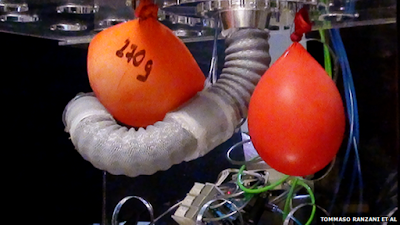
Italian engineers have built a robotic arm, aimed at improving surgical operations and inspired by the octopus.

Just like its aquatic inspiration, the robotic tentacle has no rigid skeleton; it can bend, stretch and switch between flexible and rigid states as required.

Its movement is driven by inflatable compartments and its stiffness by a central tube containing a specially selected granular medium: coffee.

When suction is applied, the granules "jam" to create the desired rigidity.

The design is described in the journal Bioinspiration and Biomimetics.

Ultimately, the researchers hope to develop the device so that it can be used in "minimally invasive surgery" - operations performed via a body cavity or a keyhole-type incision.

Read the full article here.

Sunday, May 10, 2015

Dazzled by Australia's precious opals


Dazzled by Australia's precious opals

It's exactly 100 years since the teenage Willie Hutchinson stumbled across a few pieces of opal while walking in the Australian Outback.

There with his father to prospect for gold, the youngster's chance find led to a gemstone mining boom and the establishment of the town of Coober Pedy.

Today, the settlement even refers to itself as the "opal capital of the world", with the wider Australian deposits producing more than 80% of the world's precious opals.

Coober Pedy's gemstones are known for their clear or whitish colour, but some will dazzle like a rainbow. Experts talk of "church windows" to describe examples that mimic stained glass.

Already legally defined as Australia's "National Gemstone", the precious opals could be in line for a new status - that of Global Heritage Stone Resource (GHSR).

Read the full article here.

Thursday, May 7, 2015

Ten giant animals that are long since dead


Ten giant animals that are long since dead

Today Earth is home to the heaviest animal that has ever lived: the blue whale. As far as we know, no past animal has ever weighed more. But some have been longer.

While the large dinosaurs tend to grab more than their fair share of attention, there have been many other giant animals that we will never get to see in the flesh. Some are the super-sized ancestors of creatures alive today, while others appear especially bizarre to us because they left no descendants.

The remains of yesterday's giants can help us understand how conditions on Earth have changed across the ages, because creatures often changed size in response to changes in the environment. Besides, there is something inherently fascinating about big animals that we can only see in our imaginations. Here are 10 particularly awesome extinct giants.

Aegirocassis benmoulae

What would the offspring of a whale and a lobster look like? If such a thing were possible it might look something like Aegirocassis benmoulae.

Read the full article here.

Thursday, April 30, 2015

Sentinel satellite reveals Nepal quake movement


Sentinel satellite reveals Nepal quake movement

Europe's Sentinel-1a satellite has got its first good look at the aftermath of Saturday's big quake in Nepal.

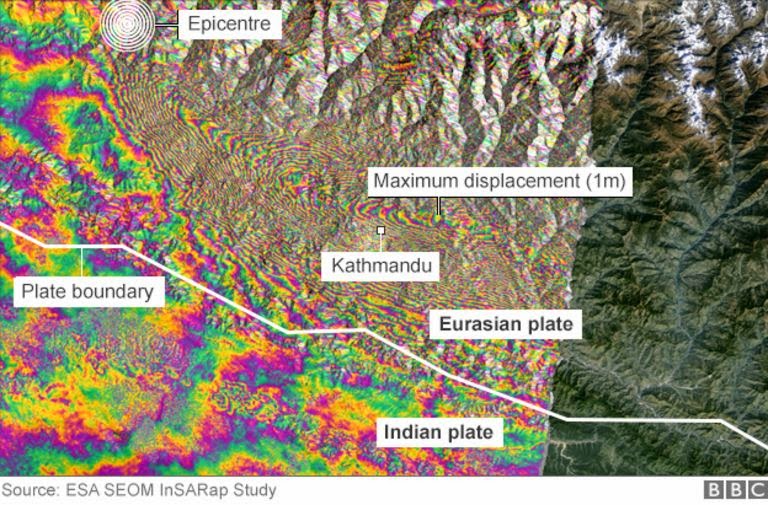
The radar spacecraft is able to sense ground movement by comparing before and after imagery acquired from orbit.

Scientists turn this information into an interferogram - a colourful, but highly technical, representation of the displacement that occurs on a fault.

The new data confirms an area of 120km by 50km around Kathmandu lifted up, with a maximum of at least 1m.

"There's a peak of slip just to the northeast of Kathmandu. Basically, what we do is count the coloured 'fringes' in this interferogram and there are about 34, so that translates to more than a metre of uplift," explained Prof Tim Wright from the UK's Nerc Centre for the Observation and Modelling of Earthquakes, Volcanoes and Tectonics (COMET).

Read the full article here.

Monday, April 27, 2015

Why Nepal is so vulnerable to quakes


Why Nepal is so vulnerable to quakes

The pictures emerging from the Nepalese capital, Kathmandu, are shocking.

Durbar square, a Unesco World Heritage Site, has been reduced to rubble. The famous Dharahara Tower has been toppled to leave just a stump.

Nepal is used to quakes – this is one of the most seismically active regions in the world. You only have to look at the Himalayas to understand that.

The mountains are being built as a consequence of the Indian tectonic plate driving under Central Asia (the Eurasian tectonic plate). These two great slabs of the Earth's crust are converging at a relative rate of about 4-5cm (two inches) a year.

The upward climb of Everest and its sister mountains is accompanied by numerous tremors.

David Rothery, a professor of planetary geosciences, at the Open University, UK, commented: "The Himalayan mountains are being thrust over the Indian plate; there are two or three big thrust faults, basically. And some very gently dipping fault will have been what moved, and gave us this event. Casualties are reported in Kathmandu, but we now wait to see how widespread the problems are."

Read the full article here.

Saturday, April 25, 2015

Hubble issues 25th birthday image


Hubble issues 25th birthday image

The Hubble Space Telescope has celebrated its silver anniversary with a picture featuring a spectacular vista of young stars blazing across a dense cloud of gas and dust.

The "Westerlund 2" cluster of stars is located about 20,000 light-years away in the constellation Carina.

Hubble was launched on Space Shuttle Discovery on 24 April, 1990.

Engineers expect the observatory to keep operating for at least another five years.

"Even the most optimistic person to whom you could have spoken back in 1990 couldn't have predicted the degree to which Hubble would rewrite our astrophysics and planetary science textbooks," commented Nasa Administrator Charlie Bolden.

"A quarter of a century later, Hubble has fundamentally changed our understanding of our Universe and our place in it."

Read the full article here.

Sunday, April 19, 2015

THE 25 BIGGEST TURNING POINTS IN EARTH'S HISTORY


THE 25 BIGGEST TURNING POINTS IN EARTH'S HISTORY

EARTH IS BORN
Birth of a planet
Earth grew from a cloud of dust and rocks surrounding the young Sun. Earth formed when some of these rocks collided. Eventually they were massive enough to attract other rocks with the force of gravity, and vacuumed up all the nearby junk, becoming the Earth. The Moon probably formed soon after, when a planet-sized chunk of rock smashed into the Earth and threw up a huge cloud of debris. This condensed into the Moon.

THE ORIGIN OF LIFE
First organisms
Nobody knows exactly when life began. The oldest confirmed fossils, of single-celled microorganisms, are 3.5 billion years old. Life may have begun a bit earlier than that, but probably not while huge rocks were still raining down on Earth. Life may have begun in warm alkaline vents on the seabed, or in open water, or on land. We don't know, and we don't know what the first organisms were like.

Read the full article here.

Wednesday, April 15, 2015

Explosive ripples suggest the Sun has "seasons"


Explosive ripples suggest the Sun has "seasons"

It's not just Earth weather that's erratic. Our own star, the Sun, also goes through changes.

It's known to go through an 11-year cycle, becoming more or less active. At its peak it explosively fires charged particles out into space, creating powerful sun storms that in turn trigger spectacular auroras on Earth.

Now it seems it has a second, shorter cycle, which lasts about 330 days. In other words, the Sun has a seasonal cycle that lasts almost one Earth year.

Earlier studies had suggested this. Researchers have confirmed it using records of solar activity spanning several decades.

The Sun is an enormous ball of extremely hot gas, which carries an electric charge. The gas is being churned around at very high speeds, and the Sun itself is in constant motion. This means the Sun is magnetic.

"If you move a charge you create a magnetic field. That's what's happening inside the Sun," says Louise Harra of University College London in the UK, who was not involved with the present study.

Read the full article here.

Coloured Pluto comes into view


Coloured Pluto comes into view

The New Horizons probe, which is bearing down on Pluto, has captured its first colour image of the distant dwarf planet.

The picture, just released by the US space agency, shows a reddish world accompanied by its biggest moon, Charon.

New Horizons is set to barrel past Pluto on 14 July.

It will acquire a mass of data that it will then return to Earth very slowly over the course of the next 16 months.

At the current separation of nearly five billion km, it takes 4.6 hours for radio signals to come back. And the bit rate is painfully slow.

But the encounter is set to be the major space event of 2015. It will complete the reconnaissance of the "classical nine" planets of our Solar System; New Horizon's flyby will mean everyone has been visited at least once by a space probe.

However, not since the Voyager 2 satellite passed Neptune in the late 1980s has a new world been revealed up close in the same way as will occur in mid-July.

Today, our best pictures of the 2,300km-wide Pluto come from the Hubble telescope. They are just blobs that make it very hard to discern anything of scientific certainty.

Read the full article here.

Monday, April 13, 2015

Porpoises, whales and dolphins use 'sound searchlights'


Porpoises, whales and dolphins use 'sound searchlights'

Researchers in Denmark have revealed how porpoises finely adjust the beams of sound they use to hunt.

The animals hunt with clicks and buzzes - detecting the echoes from their prey.

This study showed them switching from a narrow to a wide beam of sound - "like adjusting a flashlight" - as they homed in on a fish.

Researchers think that other whales and dolphins may use the same technique to trap a fish in their beam of sound in the final phase of an attack.

This could help prevent porpoises, whales and dolphins' prey from evading their capture.

By revealing these acoustic secrets in detail, researchers are hoping to develop ways to prevent porpoises, and other toothed whales, from becoming trapped in fishing nets.

The study, published in the journal eLife, was led by Danuta Wisniewska of Aarhus University.
She and her colleagues worked with harbour porpoises in a semi-natural enclosure at a conservation research centre on the coast of Denmark.


Read the full article here.

Sunday, April 12, 2015

Target Pluto fastest spaceship set for epic encounter with our remotest planet


Target Pluto fastest spaceship set for epic encounter with our remotest planet

It is the fastest spaceship ever launched and has been hurtling towards its target at a staggering 36,000mph for the past nine years. But now Nasa engineers are preparing to put their robot craft, New Horizons, on its final course – to the tiny world of Pluto.

Scheduled to reach its target on 14 July, New Horizons has already covered more than three billion miles since its launch, a distance that means signals from the spacecraft now take about 4.5 hours to reach our planet.

And the spaceship is travelling at such a speed that even tiny grains of dust have the potential to inflict serious damage if they strike the craft. “We have got round that problem in a very ingenious manner,” the mission’s principal investigator, Alan Stern, told the Observer. “We have given the craft a bullet-proof jacket. To be more precise, we have covered it in Kevlar, the material used to make body armour. That should protect it.”


Read the full article here.

Tuesday, April 7, 2015

What next for the Large Hadron Collider


What next for the Large Hadron Collider

The Large Hadron Collider (LHC) has been restarted after a two-year shutdown.

Physicists hope it could lead to discoveries that could potentially represent the biggest revolution in physics since Einstein's theories of relativity.

Among them is Prof Jordan Nash from Imperial College London, who is working on the CMS experiment at the LHC.

"We are opening a new window on the Universe and looking forward to seeing what's there," he said.

"As much as we have a lot of theories of what might be out there we don't know. We'd love to find something completely unexpected and we might, and that's the exciting bit."

Why are scientists doubling the LHC's energy?
They want a glimpse into a world never seen before. By smashing atoms harder than they have been smashed before physicists hope to peel back another veil of reality.

The aim of the various theories of physics is to explain how the Universe was formed and how the bits that make it up work.

One of the most successful of these theories is called the "Standard Model".

It explains how the world of the very, very small works.

Just as the world became very strange when Alice shrunk after drinking a potion in the children's book Alice's Adventures in Wonderland, physicists have found things are quite different when they study the goings on at scales that are even smaller than the size of an atom.

By doubling the energy of the LHC, it will enable them to discover new characters in the wonderful and mysterious tale of how the Universe works and came to be.

Read the full article here.

Monday, March 23, 2015

Rosetta's comet is spinning down - BBC


Rosetta's comet is spinning down

The comet being observed by Europe's Rosetta satellite is very gradually spinning down.

The icy dirt-ball takes 12.4 hours to complete one rotation, but mission controllers have noticed that this is extending by about a second a day.

And this rate of change is increasing as Comet 67P gets more active.

"The gas jets coming out of the comet - they are acting like thrusters and are slowing down the comet," said flight director Andrea Accomazzo.

The European Space Agency official was speaking this week at the Royal Aeronautical Society in London.

He was describing how his team has learnt to fly Rosetta around the 10-billion-tonne, 4km-wide body with remarkable precision.

Read the full article here.

Friday, March 13, 2015

Global CO2 emissions 'stalled' in 2014 - BBC


Global CO2 emissions 'stalled' in 2014

The growth in global carbon emissions stalled last year, according to data from the International Energy Agency.

It marks the first time in 40 years that annual CO2 emissions growth has remained stable, in the absence of a major economic crisis, the agency said.
Annual global emissions remained at 32 gigatonnes in 2014, unchanged from the previous year.

But the IEA warned that while the results were "encouraging", this was "no time for complacency".

"This is both a very welcome surprise and a significant one," said IEA Chief Economist Fatih Birol.

Read the full article here.

Wednesday, March 11, 2015

Solar Impulse Piccard crosses Arabian Sea to India - BBC


Solar Impulse Piccard crosses Arabian Sea to India

Solar Impulse, the fuel-free aeroplane, has successfully completed the second leg of its historic attempt to fly around the world.

Project chairman, Bertrand Piccard, piloted the vehicle from Muscat in Oman to Ahmedabad in India, crossing the Arabian Sea in the process.

Tuesday's journey took just over 15 hours.

The distance covered - 1,468 km - set a new world record for a solar-powered plane.

The vehicle has another 10 legs ahead of it over the course of the next five months.

Included in that itinerary will be demanding stretches when the craft has to fly over the Pacific and Atlantic oceans.

Read the full article here.

Monday, March 2, 2015

Forest tree seeds arrive at Svalbard's 'Doomsday vault' -BBC News


Forest tree seeds arrive at Svalbard's 'Doomsday vault'

The Svalbard "doomsday" vault - widely known for protecting global food crop seeds - has accepted its first delivery of forest tree species seeds.

Norway spruce and Scots pine samples have entered the vault inside a mountain on the Arctic archipelago.

The frozen depository opened in 2008 and is designed to withstand all natural and human disasters.

Researchers hope the tree seed samples will help monitor long-term genetic changes in natural forests.

Frozen forests

Spruce seeds (Image: Erkki Oksanen)
The Norway spruce seeds were the first of many to enter the Svalbard Global Seed Vault
"The possibility to have seed samples stored in the vault is a great opportunity to complement our forest tree gene conservation, which is based on in situ gene reserve forests," explained Mari Rusanen, a researcher for Natural Resources Institute Finland (Luke), one of the organisations involved in the seed collection.

Read the full article here.

Thursday, February 26, 2015

Prehistoric caiman's bite 'twice as strong' as T-Rex's -BBCC News


A prehistoric caiman that lived in the Amazon region about eight million years ago had a bite twice as powerful as that of a Tyrannosaurus Rex, Brazilian scientists say.

A team of Brazilian paleontologists calculated the strength of a bite by the Purussaurus brasiliensis, a reptile that lived in the Late Miocene period.

They said it could exert a pressure up to 11.5 tonnes.

That is 20 times the strength of a white shark's bite.

Tito Aureliano, one of the co-authors of the study, said the animal's head was better structured for biting than that of the T-Rex.

The Purussaurus's stout and robust skull with conical teeth were made for gripping large prey.

The findings by the team drawn from a number of research and academic institutions were published in the online Plos One journal.

Read the full article here.

Infected chickens cause 'growing concern' - BBC News


Concerns are growing about antibiotic resistance of food-poisoning bacteria carried by poultry, according to a new report.

Campylobacter, which is present in many shop chickens, is becoming resistant to front-line drugs, a study in 28 EU countries has found.

It reduces the options for treating human infections, say scientists.

A separate report by the UK's Food Standards Agency found campylobacter in UK chickens remained at high levels.

The report from the European Food Safety Authority (Efsa) and European Centre for Disease Prevention and Control (ECDC), monitored antimicrobial drug resistance in humans, animals and food during 2013.

Mike Catchpole, chief scientist at the ECDC, said antibiotic drug resistance in bacteria present in shop chickens was "of concern considering that a large proportion of human campylobacter infections come from handling, preparation and consumption of broiler meat".

Read the full article here.